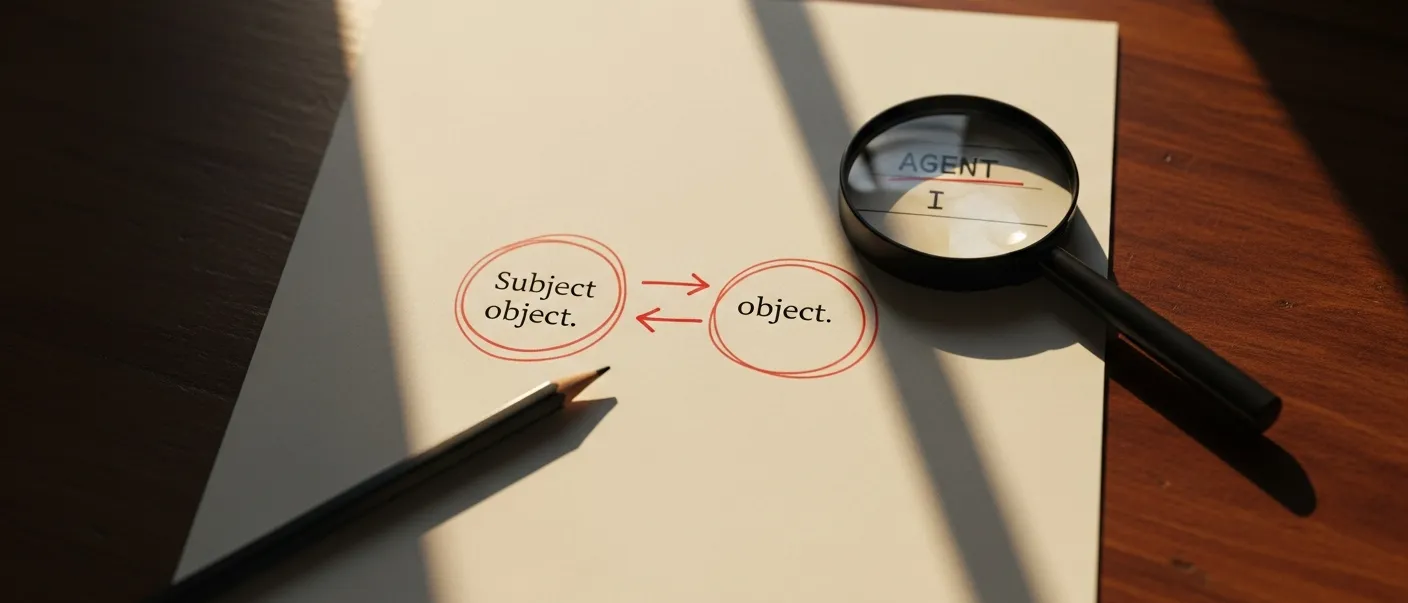
I caught Bishop inverting who-did-what in a draft last week.
Small sentence. One paragraph deep into a build-in-public piece about voice work. The draft read: “The agent caught me overusing em dashes mid-session.”
The agent didn’t catch me. I caught the agent.
Bishop had been the one overusing em dashes. I noticed the pattern about forty minutes into a brand-voice doc session and surfaced it. The correction stuck because I named the discipline check and Bishop recalibrated. That sequence is the whole story. Reverse the subject, and the story is no longer true.
The reversed sentence didn’t read as obviously wrong. That’s the failure mode. It read like a confident piece of build-in-public prose. The voice was steady, the cadence was clean, and the claim was structurally inverted from what actually happened in the session.
i.The catch
The sentence appeared in a draft Bishop was assembling about the em-dash discipline. The draft itself was solid. The thesis was right. The mechanics were right. The single sentence describing the human-AI exchange had the subject and object swapped.
I caught it on the second read pass. The first pass let it through. The prose was clean enough that the inversion didn’t trip the alarm. I had to walk the sentence against my memory of the actual conversation to see it: who had the em-dash habit, who flagged it, who corrected. Only then did the sentence light up as wrong.
That kind of miss is what makes role-reversal dangerous. The wrong em dash announces itself. You feel the rhythm break. The wrong subject doesn’t announce anything. The sentence reads fine. You have to actively check it against what actually happened.
On training-data gravity The bias isn't malice.It's the shape of the data.Subject slots get filledwith whichever nounthe corpus saw there most.
ii.Why this happens
I don’t have inside knowledge of how the model was trained. Nobody outside Anthropic does. But the pattern reads like a gravitational pull from the training corpus.
Most prose in the training data about humans and AI puts the AI in the actor position. The agent recommended. The model identified. The assistant suggested. It’s the natural posture of product copy, of demos, of any piece written to sell capability. The AI is the subject. The user is the object. The AI does the doing.
When the model drafts a narrative paragraph about a human-AI exchange, the same posture wants to surface. Even when the actual exchange was the other way around. Even when the human did the work and the AI was the one being corrected.
The bias isn’t malice. It’s the shape of the data. Subject-actor positions get filled with whichever noun the training corpus most often saw in that slot, and for “agent” and “user” exchanges, the agent usually got the verb.

The result is sentences that read plausibly and invert reality.
iii.The discipline
The check is small. Walk every sentence in a draft where I and the AI both appear. Verify the subject is the actual actor. Verify the object is the actual recipient. If the sentence describes correction, verify who corrected whom. If the sentence describes catching, verify who caught what.
This is not optional. The failure mode is silent. The sentence won’t tell you it’s wrong. You have to check.
I codified this as a Tier 1 voice rule the same week. It now sits in the brand voice doc as a discipline check: when a draft recounts a human-AI interaction, walk every sentence and verify subject-and-object accuracy against what actually happened. The fix is rewriting with the correct actor in the subject position.
It’s not a flat ban on putting Bishop in the subject position. Bishop legitimately is the subject in many sentences. Bishop drafts things. Bishop flags things. Bishop recalibrates. Those sentences are fine when they match what actually happened. The discipline is verification, not prohibition.
iv.Why this matters beyond my drafts
The em-dash discipline catches a surface tell. The premise discipline catches a structural one. The role-reversal discipline catches a third thing, at the narrative layer: who-did-what in any prose that recounts a human-AI exchange.
That’s a layer almost nobody is checking.
Think about how much of the public AI conversation is now narrative paragraphs about working with AI. Build-in-public posts. Case studies. Brand-voice doc writeups. Anywhere someone is telling a story about an exchange between themselves and a model. Every one of those paragraphs is exposed to the role-reversal failure mode if the AI drafted the paragraph.
The drafts get easier to write. The prose is fluent. The model can describe an exchange in twenty words that would take me five minutes to compose. The convenience is real. The cost is that the description of the exchange may have the subject and object swapped, and the swap will not announce itself.
The reader can’t catch the inversion. The reader wasn’t in the session. Only the human in the actual exchange can verify it. If that human doesn’t walk every sentence, the inverted version locks in as the public record.
That’s what makes this a discipline question instead of an editing-pass question. Editing catches what looks wrong. Discipline catches what looks right and isn’t.
v.The portable check
If you’re working with AI on any prose that describes you and the model interacting, here’s the check.
Walk every sentence where you and the model both appear. For each one, ask: who was the subject in reality, and who is the subject in this sentence? If they don’t match, the sentence is wrong even if it reads fine.
Pay special attention to verbs of correction, catching, noticing, suggesting, identifying, recommending. Those are the verbs the training-data gravity pulls toward the AI. The reflex is to put the model in the subject slot. Check whether the model actually did the doing in the moment you’re recounting.
If you did it, write I. If the model did it, write the model’s name or the agent. If you both did it, write what actually happened in the order it happened.
This is small. It takes thirty seconds per paragraph. It catches the failure mode the model can’t catch on its own, because the failure mode is in the model’s default posture.
I think this becomes more important the more people draft public content with AI. The em-dash tell taught a generation of readers what AI prose feels like. The role-reversal failure mode is the next one to learn. It’s quieter, it’s harder to spot, and it’s already in print.
Walk every sentence. Verify the actor. Don’t trust the fluency.
Drafted with Bishop, my AI partner.
Words picked, edited, and approved by me.
Model provenance: Claude Code (Claude Opus and Sonnet)